
Chinese Hibiscus by Margaret Lee
5TH JUNE 2026 - ASU #528
One of our favourite sayings here at Inspirations is that every stitched piece is a story waiting to be told.
The piece we’re featuring today has such a rich and engaging story, that to do it justice we need to tell it in three parts.
First, we’re going to set the scene by finding out why the Chinese Hibiscus flower symbolises wealth and accomplishment yet carries with it a poignant caveat.
Secondly, we’ll explore the fascinating art that is Chinese brush painting, which is as unforgiving for painters as cut thread embroidery is for stitchers.
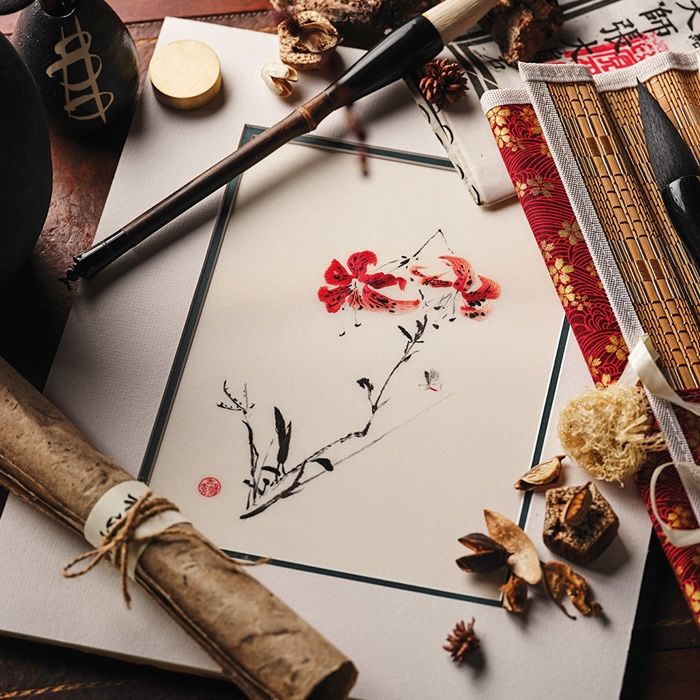
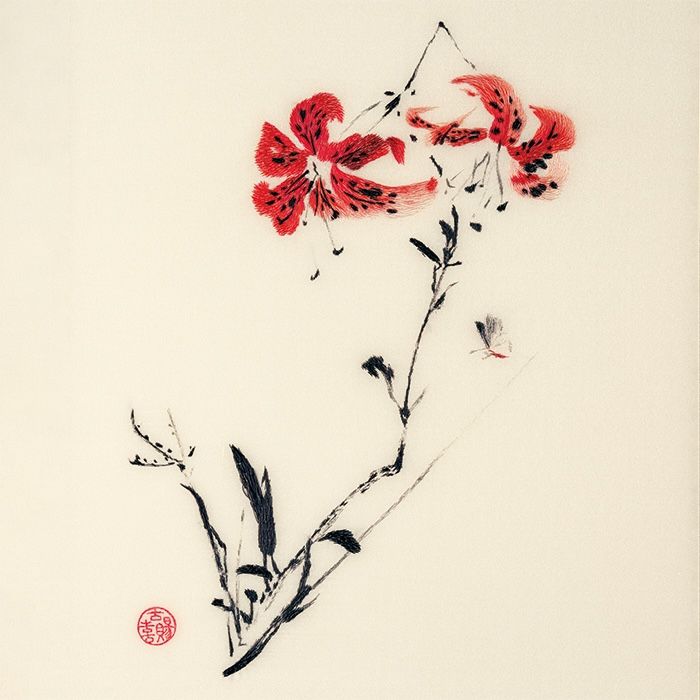
Then we’ll bring it all together and explain the significance of parts one and two in relation to our feature project as we reveal the incredible talent and depth of skill on display in the remarkable piece Chinese Hibiscus by Margaret Lee from The Handpicked Collection 6.
Get ready… this is going to be good!
Part One | Chinese Hibiscus
The hibiscus has held a special place in Chinese culture for centuries. This gloriously vivid flower is a symbol of wealth, fame, and personal accomplishment. Across centuries of Chinese poetry and decorative art, the hibiscus turns up again and again as a kind of floral shorthand for success and glory - vibrant, bold, and impossible to overlook.
And then you find out the secret.
For all its associations with fame and lasting accomplishment, each individual hibiscus bloom only lives for a single day.
It opens in the morning in a blaze of colour and by nightfall, it's gone.
All that symbolism of wealth and enduring glory, carried by a flower that doesn't make it to sunset.
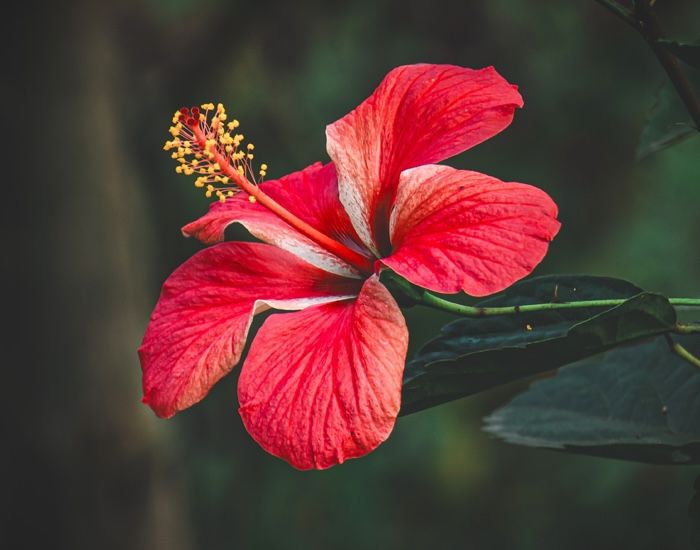
But then you realise that the very next day, just as the new sun dawns, so too a new bloom opens, equally as vivid and generous as the one it replaces.
The hibiscus doesn't mourn what's gone - it simply blooms again, morning after morning, day after day.
It is this quiet, steadfast relentlessness and proliferation that earns its cultural status. The hibiscus isn't just a symbol of glory; it's a meditation on the nature of glory.
Brilliant, fleeting, and endlessly renewed. The caveat? Savour what's in front of you, because it won't be here tomorrow. But take heart, something just as beautiful will be.
Part Two | Chinese Brush Painting
Chinese brush painting is one of the world's oldest and most philosophically rich visual traditions dating back more than two thousand years. And yet for all its antiquity, it feels remarkably alive.
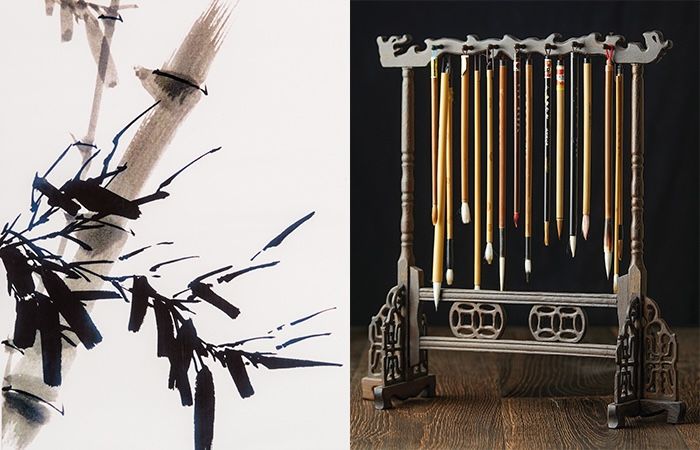
To Western eyes, its most striking quality is perhaps what it doesn't do: it makes no attempt to reproduce its subject with photographic accuracy.
Rather, the brush painter's goal is to capture qi - the animating life force, the inner spirit - that makes a subject like the hibiscus not merely a botanical specimen, but a living presence. Not what it looks like. What it feels like to be in its company.
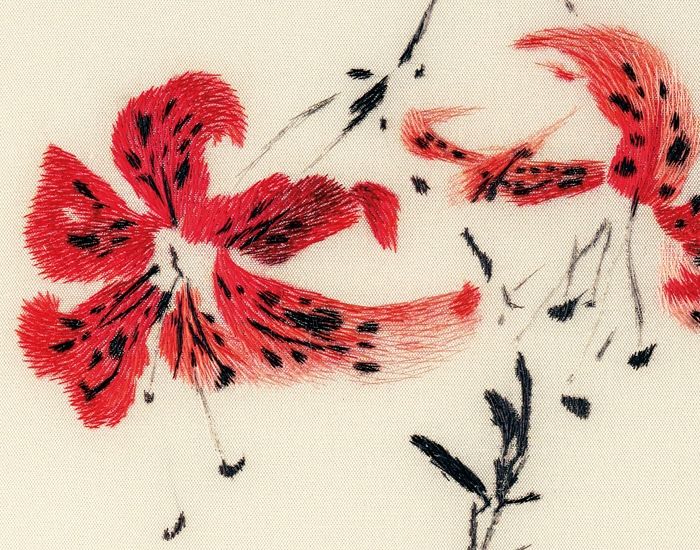
Part of the discipline of this traditional technique is an absolute commitment to the single stroke. The painting surface, whether silk or paper, is absorbent and unforgiving.
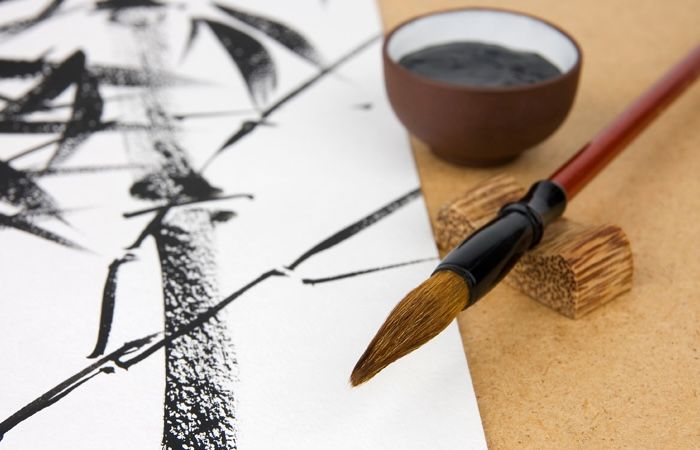
There is no sketching, no correction, no painting over. The artist studies the subject intently - sometimes for hours, sometimes for days - internalising its essence before a brush is ever lifted.
Then, in a moment of concentrated flow, the image is committed to the surface in one unbroken session.
There is no going back. Which very much reminds us of working a cut thread embroidery piece. But that's another story. For now, let's find out how the Chinese Hibiscus and Chinese Brush Painting intersect in this Random Stitch embroidered masterpiece.
Part Three | Random Stitch Embroidery
Margaret Lee is, quite simply, one of the most celebrated designers, teachers, and authors in Chinese embroidery today, having dedicated much of her career to preserving the traditions of this ancient technique.
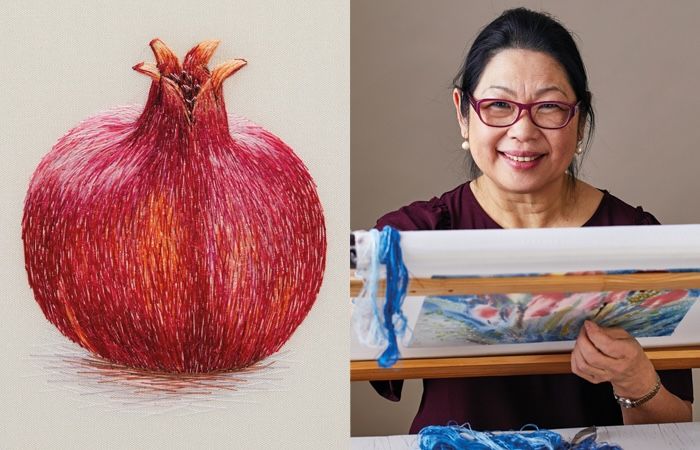
Who better, then, to take on the challenge of recreating the cultural essence of a Chinese icon and replicating it in the style of Chinese brush painting? One may even ask - can this even be done using needle and thread?
In a sublime display of both design and technical brilliance, Margaret has harnessed her vast skill and experience to create this extraordinary piece of stitched art.In a sublime display of both design and technical brilliance, Margaret has harnessed her vast skill and experience to create this extraordinary piece of stitched art.
Let us share with you a little of the secret behind how she achieved it, thanks to a very special technique known as Random Stitch Embroidery.
Known in its original Chinese as ‘chaotic stitch embroidery’ - which tells you something immediately about its spirit - random stitch embroidery is a method built on pairs of crossed stitches, placed with extraordinary care in terms of angle, length, spacing, and direction.
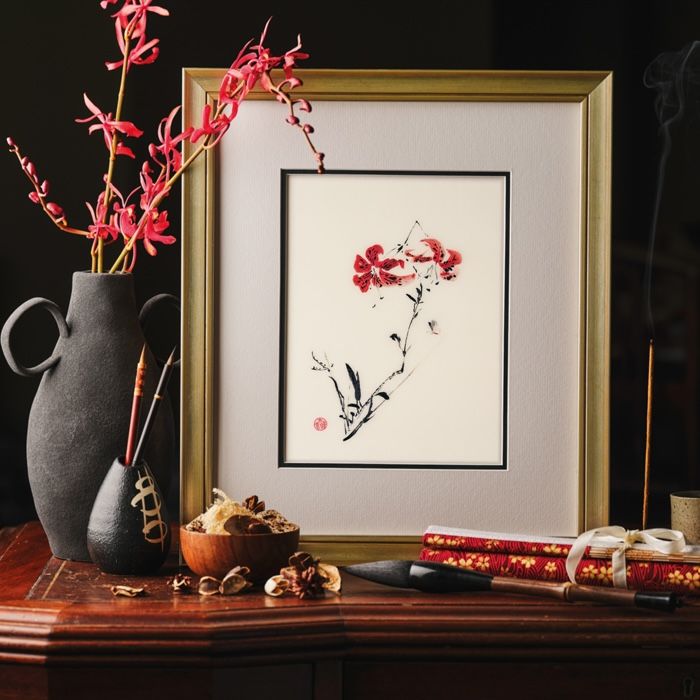
And yet the cumulative effect is one of fluid, spontaneous movement. Ordered chaos, if you will.
What Margaret is doing with needle and thread is precisely what the brush painter does with ink - she isn't stitching a picture of a hibiscus. She is capturing its qi.

The palette is deliberately restrained - just seven shades of red and three of grey, worked on ivory silk taffeta. In less skilled hands that might feel limiting. Here, it is a masterstroke - the full tonal range of a hibiscus in bloom, conjured from ten colours and the finest Chinese filament silk.
Perhaps the most extraordinary aspect of this design is the breathtaking sense of movement Margaret has brought to the hibiscus petals - as though capturing, in silk, the very fleeting nature of the flower's beauty.
Coupled with some of the finest shading we have ever seen in a stitched piece, replicating the tonal nuance of brush strokes with astonishing accuracy, this is, quite simply, a triumph.
The finished piece measures 19.5cm x 13.5cm (7⅛” x 5¼”). Small in scale, extraordinary in presence.
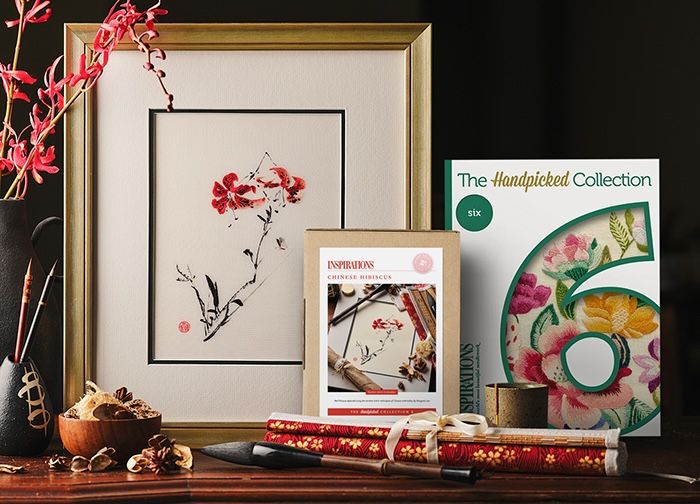
Ready-to-Stitch kits for Chinese Hibiscus are now available and include all the Chinese filament silk threads and the gorgeous ivory silk taffeta fabric Margaret uses in her original, which even comes with the design pre-printed so no pattern transfers required.
Thank you, Margaret, for continually striving to create extraordinary pieces of stitched art that inspire us.
